
At SkinVision, we are committed to scientific integrity, real-world validation, and clinical relevance. As one of the few skin cancer detection apps that has consistently invested in independent clinical research, we collaborate with leading academic and medical institutions to validate not only our algorithm’s accuracy, but also its practical implementation and user experience.
WHAT ARE CLINICAL STUDIES?
Clinical studies are carefully designed research projects carried out by medical experts to test whether a medical device works as it should. In the case of SkinVision, these studies checked whether the app could accurately identify both concerning (malignant) and harmless (benign) skin spots. Whenever possible, the results were compared to histopathology – the golden standard laboratory test where skin lesions are examined under a microscope – or to expert dermatologist evaluations.
KEY RESULTS FROM OUR LARGEST VALIDATION STUDY AT A GLANCE
Our largest clinical study was carried out in collaboration with Erasmus MC (NL) and is published in a peer-reviewed journal (Sangers, et al, 20221).
What was the goal of this study: Researchers wanted to check how accurate the SkinVision app is at detecting skin cancer spots.
How was the study designed?
The study took place in two hospitals in the Netherlands (Erasmus MC Cancer Institute and Albert Schweitzer hospital). Adults with a suspicious skin spot were invited to take part.
Each spot was first checked by one of the participating doctors and thereafter the SkinVision app was used to photograph the skin spot (on iPhone or Android).
The results from the SkinVision app were compared with the doctor’s diagnosis, and if indicated, confirmed by histopathology.
What did the study find?
In total, 372 people participated in the study, covering 785 skin spots.
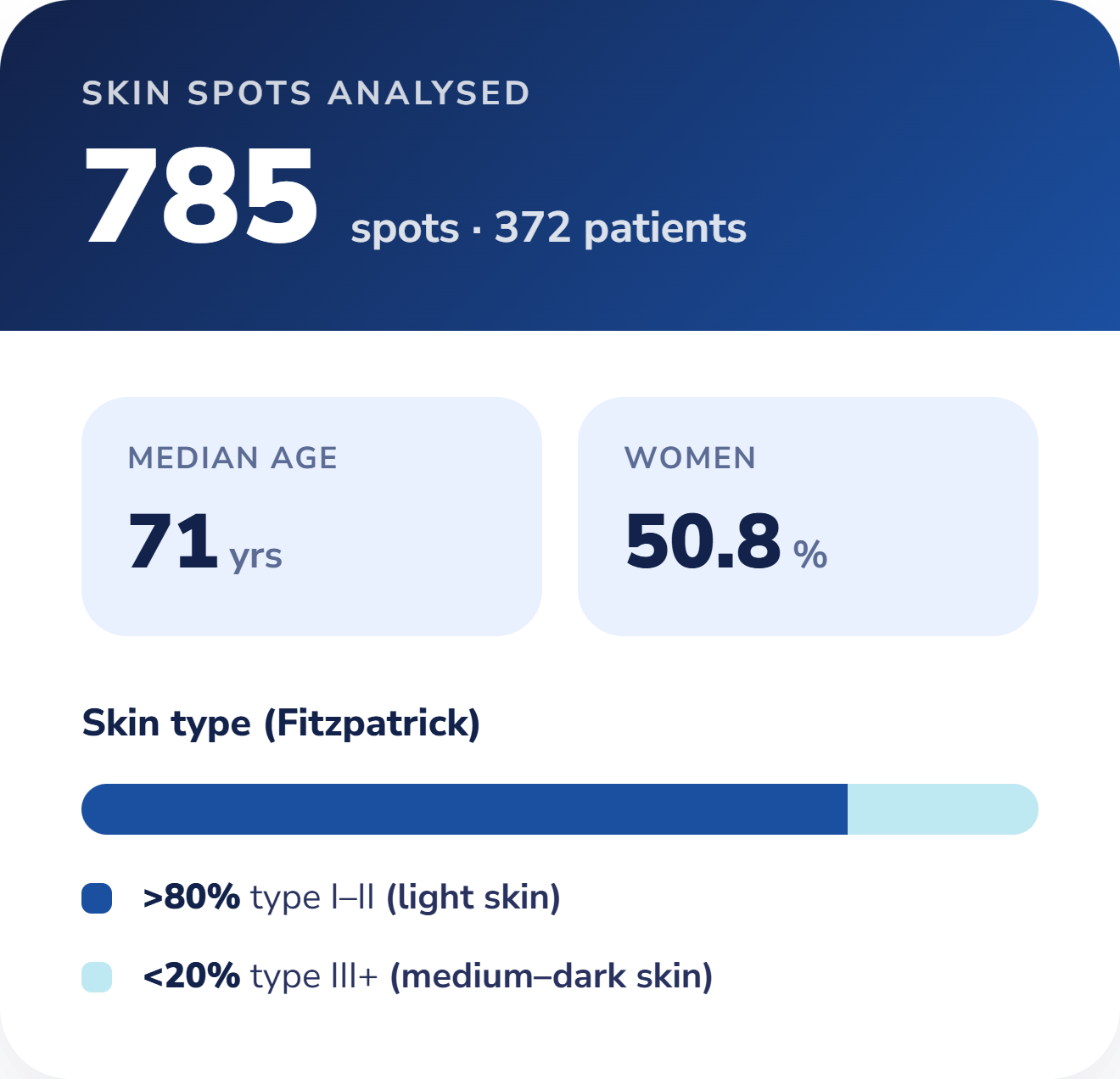
- Out of the 785 skin spots, 275 effectively turned out to be cancerous of precancerous.
- 86.9% of these 275 pre(cancerous) spots were correctly detected as ‘high risk’ by the SkinVision app.
- The sensitivity in recognising melanoma and epidermal skin cancers was well above 90%.
- 80% of harmless skin spots were detected correctly as ‘low risk’ by the SkinVision app.
- 86.9% of these 275 pre(cancerous) spots were correctly detected as ‘high risk’ by the SkinVision app.
What does this mean?
This clinical study showed that SkinVision is highly accurate in spotting skin cancers and precancerous spots in a hospital setting. It picked up the vast majority of ‘high risk’ spots. But it also avoided many false alarms by correctly identifying harmless spots.
The SkinVision app can be a helpful ‘triage’ tool for self-checks and deciding when to see a doctor. More research is still undergoing, especially in everyday users and people with darker skin tones.
VALIDATION IN THE REAL-WORLD
Our largest real-world study was carried out in collaboration with insurer CZ group (NL) and is published in a peer-reviewed journal (Smak Gregoor, et al, 20233).
What was the goal of this study: To find out how the SkinVision app affects dermatology care in real life.
How was the study set up?
- 2.2 million adults were invited to use the SkinVision app for free for one year (2019).
- 47,879 people signed up, 20,777 became active users, and 18,960 had full 12-month data available for analysis.
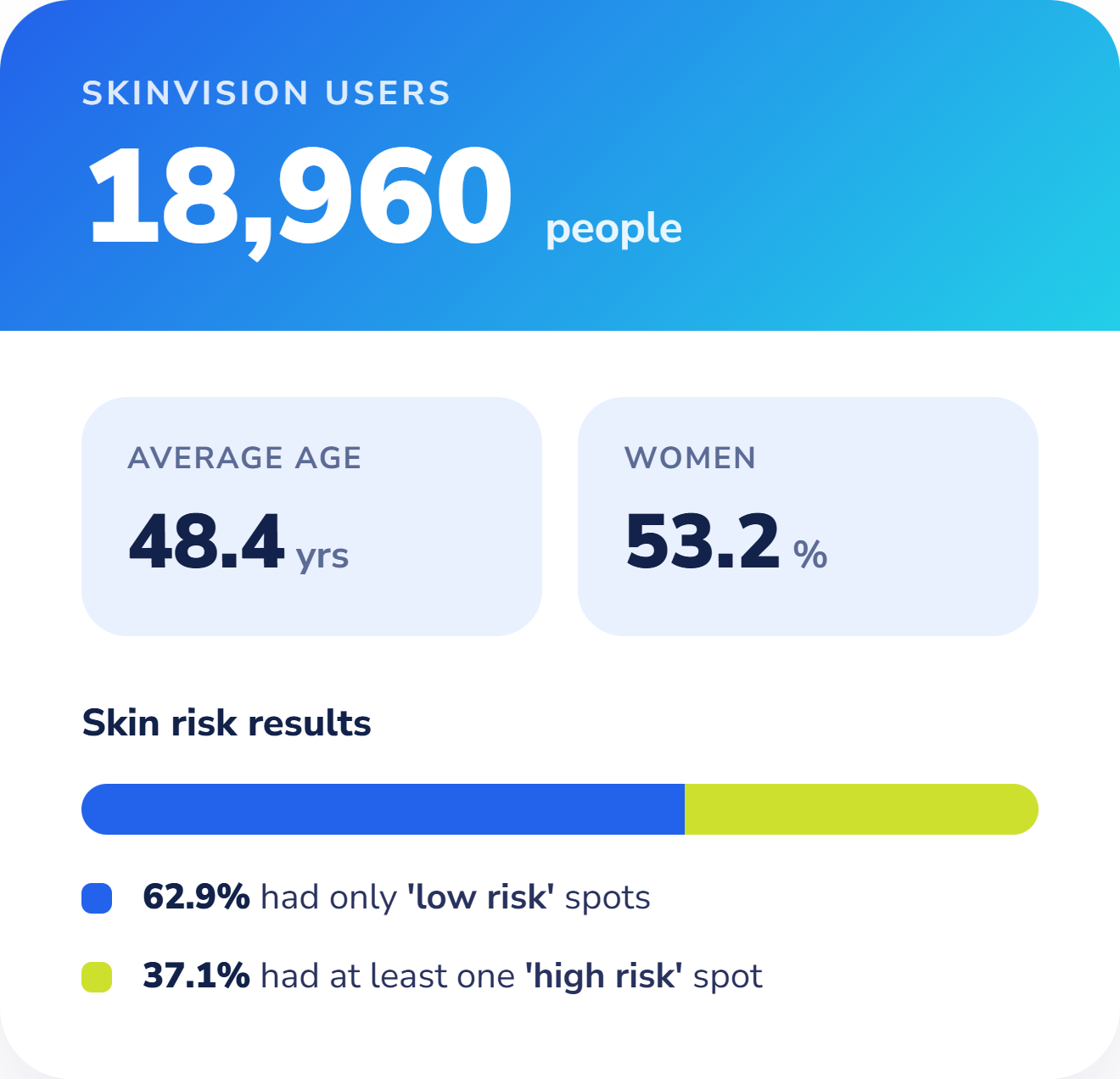
- SkinVision users were compared (“matched”) to non-users (56,880) with the same demographic settings.
What did the study find?
- SkinVision users had more skin (pre)cancers spots detected.
- 6.0% had dermatology claims for cancer or precancer versus 4.6% of non-users.
- 32% were more likely to have a skin (pre)cancer diagnosed with the SkinVision app.
- SkinVision users also had more dermatology claims for harmless moles and benign spots compared to non-users.
What does this mean?
In everyday life, people who used the SkinVision app had earlier and more frequent detection of skin cancers and precancerous spots compared to those who didn’t use the app. This shows that AI-powered skin checks can make a real difference in population health.
As a known effect of increased health vigilance, it also means more people visited dermatologists — not only for cancers, but also for harmless spots.
CLINICAL PERFORMANCE OVER TIME
The accuracy of the SkinVision app has been evaluated in several peer-reviewed clinical studies1-5and is supported by a large dataset of histopathology-confirmed global customer results6,7 including both malignant and non-malignant skin lesions.
The largest validation study, conducted in partnership with Erasmus Medical Center (NL), was published in Dermatology (Sangers et al., 2022)1.
The performance of SkinVision’s algorithm, particularly the latest version integrated with a convolutional neural network (CNN), has demonstrated high sensitivity in detecting premalignant and malignant lesions.
For the intended user group – individuals at risk of developing skin cancer – the sensitivity of SkinVision app for correctly identifying (pre-)malignancy was 87% (SkinVision app version 6.0) in a clinical multicentre study, with a high sensitivity for malignant melanoma (92.1%) and squamous cell carcinoma (98.6%) and a specificity of 80.1%.1,8
Notably, the algorithm’s performance has been confirmed in real-world conditions through extensive internal bench testing and independently validated in a population-based insurance study.7,9 Results based on our internal bench test database (December 2024 release), consisting of both customer-validated data and data from previously conducted studies, showed overall a sensitivity of more than 90%. Specificity, calculated on a randomly selected set of 5,000 images from our production database (excluded from AI training), reached 89%7.
More information on our scientific evidence and our AI algorithm is expected to be published on our website soon.
Here is an overview of the articles we have collaborated on with several research centres (the text refers also to some internal files from SkinVision which are listed between the list of articles):
- Sangers T, Reeder S, van der Vet S, et al. Validation of a Market-Approved Artificial Intelligence Mobile Health App for Skin Cancer Screening: A Prospective Multicenter Diagnostic Accuracy Study. Dermatology. 2022;238(4):649-656.
https://pubmed.ncbi.nlm.nih.gov/35124665 - Smak Gregoor AM, Sangers TE, Eekhof JAH, et al. Artificial intelligence in mobile health for skin cancer diagnostics at home (AIM HIGH): a pilot feasibility study. eClinicalMedicine. 2023;60.
https://pubmed.ncbi.nlm.nih.gov/37261324/ - Thissen M, Udrea A, Hacking M, von Braunmuehl T, Ruzicka T. mHealth App for Risk Assessment of Pigmented and Nonpigmented Skin Lesions-A Study on Sensitivity and Specificity in Detecting Malignancy. Telemed J E Health. 2017;23(12):948-954.
https://pubmed.ncbi.nlm.nih.gov/28562195/ - Maier T, Kulichova D, Schotten K, et al. Accuracy of a smartphone application using fractal image analysis of pigmented moles compared to clinical diagnosis and histological result. J Eur Acad Dermatol Venereol. 2015;29(4):663-667.
https://pubmed.ncbi.nlm.nih.gov/25087492/ - SkinVision ML Algorithm Technical Overview (Data on File)
- SkinVision app bench test report (Data on File)
- SV1151_-_Clinical_Evaluation_Report_(CER)_-_v3.1 (Data on File).
- Smak Gregoor AM, Sangers TE, Bakker LJ, et al. An artificial intelligence-based app for skin cancer detection evaluated in a population based setting. NPJ Digit Med. 2023;6(1):90.
https://pubmed.ncbi.nlm.nih.gov/37210466/ - Howe S, Smak Gregoor A, Uyl-de Groot C, Wakkee M, Nijsten T, Wehrens R. Embedding artificial intelligence in healthcare: An ethnographic exploration of an AI-based mHealth app through the lens of legitimacy. Digit Health. 2024;10:20552076241292390.
https://pubmed.ncbi.nlm.nih.gov/39525560/ - Sangers TE, Wakkee M, Moolenburgh FJ, Nijsten T, Lugtenberg M. Towards successful implementation of artificial intelligence in skin cancer care: a qualitative study exploring the views of dermatologists and general practitioners. Arch Dermatol Res. 2023;315(5):1187-1195.
https://pubmed.ncbi.nlm.nih.gov/36477587/ - Sangers TE, Wakkee M, Kramer-Noels EC, Nijsten T, Lugtenberg M. Views on mobile health apps for skin cancer screening in the general population: an in-depth qualitative exploration of perceived barriers and facilitators. Br J Dermatol. 2021;185(5):961-969.
https://pubmed.ncbi.nlm.nih.gov/33959945/ - Sangers TE, Nijsten T, Wakkee M. Mobile health skin cancer risk assessment campaign using artificial intelligence on a population-wide scale: a retrospective cohort analysis. J Eur Acad Dermatol Venereol. 2021;35(11):e772-e774.
https://pubmed.ncbi.nlm.nih.gov/34077573/ - de Carvalho TM, Noels E, Wakkee M, Udrea A, Nijsten T. Development of Smartphone Apps for Skin Cancer Risk Assessment: Progress and Promise. JMIR Dermatol. 2019;2(1):e13
https://www.sciencedirect.com/org/science/article/pii/S2562095919000023