
Know Your Skin Type
Your skin type plays a big role in your risk of developing skin cancer. SkinVision helps you:
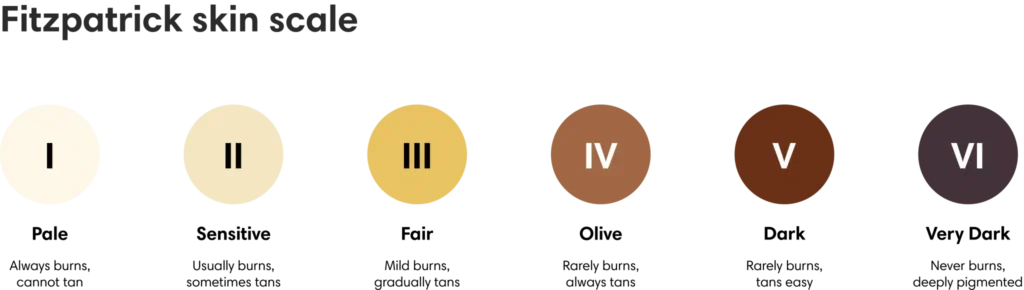
- Identify your skin type using the Fitzpatrick scale (types I to VI).
- Understand your personal risk profile.
- Get customized advice to monitor and protect your skin.
Based on your Skin Type and Risk Profile, the SkinVision app guides you through a personalised skin health journey supporting you before and after your doctor visits if a high-risk spot is detected.
Knowing the Fitzpatrick Scale
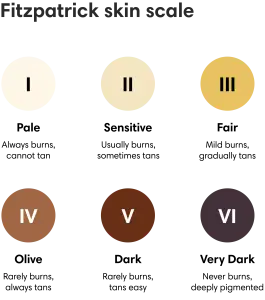
We use the Fitzpatrick scale, a dermatologist-standard classification of skin colour and sun exposure. There are six skin phototypes, from light to dark. People with skin types I and II have the highest risk of skin cancer, while types V and VI have the lowest. This is because those with more pigmentation have more natural protection from the sun. However, darker-skinned people can still develop skin cancer.
Open the app and answer a few questions to discover your skin type and get personalized skin health guidance.
Monk Skin Tone Scale
We are also exploring the addition of the Monk Skin Tone Scale, a more inclusive and modern framework for representing a wider range of skin tones. While not yet part of the app, we are evaluating it as part of our commitment to improving accuracy and equity for people with skin of colour. The Monk Skin Tone Scale uses 10 colour tones that range from very light to very dark. Instead of focusing on how the skin reacts to the sun, it simply describes the visible tone of a person’s skin. This creates a more inclusive spectrum, especially for people with skin of colour, and helps ensure that technology is tested and evaluated across a broad range of real skin tones.